Acts 23-24Paul in Caesarea - 2 years in house arrest
Few random points about Paul.
- Although he knows that Ananias, the high priest, is an unworthy man, he respects the office of the high priest.
Acts 23: 5 Paul replied, “Brothers, I did not realize that he was the high priest; for it is written: ‘Do not speak evil about the ruler of your people.'
- Several epistles were written during the two years Paul was in house arrest.
About Marcus Antonius Felix 1) He was a freed man who had once been a slave in the household of the daughter of Mark Anthony and Octavia, the sister-in-law of Tiberias Caesar. 2) His brother Pallas was a high official under the emperor Claudius. 3) His wife was the youngest daughter of Herod Agrippa, through whom he gained a “rather accurate knowledge of „The Way‟” 4) He had the unrest between the Gentiles and Jews in Caesarea Philippi to manage. 5) He kept Paul under guard for 2 years and did nothing to resolve the case.
The Significant differences between the Pharisees and the Sadducees: a. The belief in the resurrection of the dead angels, demons and immortality – the Pharisees believed in these things; the Sadducees did not. b. The commitment to the law and religious rituals – the Pharisees were fanatical about keeping the Law and all the rituals and the Sadducees were not. c. The way the people viewed them – the Pharisees were respected; the Sadducees were hated.
Paul's shrewdness
Acts 23: 6 Then Paul, knowing that some of them were Sadducees and the others Pharisees, called out in the Sanhedrin, “My brothers, I am a Pharisee,descended from Pharisees. I stand on trial because of the hope of the resurrection of the dead.”
The above portion shows Paul being very shrewd, just as Jesus commanded us to be.
I am sending you out like sheep among wolves. Therefore be as shrewd as snakes and as innocent as doves. (Mat 10:16)
This blog post explains it very well: http://pilgrimwatch.com/shrewdness-and-wisdom/
“The Way”
a. Christianity is not a set of doctrines that you intellectually assent to
b. Christianity is a way of living.
Acts 25-26
Paul makes his case before Agrippa
 Felix
is recalled to Rome and replaced by Festus. He had no knowledge of the
Christian belief system. He wanted to ingratiate himself with the Jews
he was now governing. But Paul appeals to Caesar. Meanwhile, Herod
Agrippa II and his sister Bernice are interested in hearing about Paul's
case. His opinion was that Paul could have been released had he not
appealed to Caesar. Maybe Paul did this for the opportunity to preach
Christ in Rome. In fact, during the trial, Paul tried to induce Agrippa
to personally respond to the Gospel.
Felix
is recalled to Rome and replaced by Festus. He had no knowledge of the
Christian belief system. He wanted to ingratiate himself with the Jews
he was now governing. But Paul appeals to Caesar. Meanwhile, Herod
Agrippa II and his sister Bernice are interested in hearing about Paul's
case. His opinion was that Paul could have been released had he not
appealed to Caesar. Maybe Paul did this for the opportunity to preach
Christ in Rome. In fact, during the trial, Paul tried to induce Agrippa
to personally respond to the Gospel.
Paul's says, “I put many saints in prison and when they were put to death I cast my vote against them.” Two possible meanings for this statement: a) Paul agreed with the death penalty. b) Paul was a former member of the Sanhedrin.
The clarity of Pauls' call from God and the role it played in his life led him to display tremendous perseverance. God still calls individuals to specific tasks and specific places.
Acts 27-28
Paul stays in Rome awaiting his hearing
We are in the last chapter of Acts. Luke does not tell us the outcome of Paul's appeal to Caesar.
The voyage from Caesarea to Rome was eventful:
- Luke and Aristarchus elect to go with Paul to Rome
- The Roman centurion, Julius, and Paul quickly develop a relationship of friendship and respect
- Paul was asked to play a part in the decision's made aboard ship
The story of the storm is like the story of Jonah in reverse; The presence of an obedient servant of God in the midst of unbelievers is often a great blessing to them.
The snake that bit Paul on Malta was a “sign” – “…(they) will pick up snakes with their hands and when they drink deadly poison it will not hurt them at all.”
“The First Man of Malta - title given by Publius” is an actual title verified by archaeology. It just shows how much Luke is a reliable historian.
When Paul arrives in Rome, he follows the same strategy as a prisoner that he did as a free man. He quickly convened the Jews and starts to reason with them. He then turns to the gentiles to proclaim the good news.
What happened to Paul? Tradition tells us that Paul died in Rome after the great fire (probably set by Nero himself) in 64 A.D., which Nero blamed on the Christians. The quote from Tacitus shows the hatred some had for the followers of “Christus.”
It is believed that Paul was released from his first imprisonment in Rome. Clement says Paul reached the limit of the west, which may mean he got to Spain. If so, Paul returned to Rome from Spain and Nero's persecution had begun. Paul was a primary target. He wrote his letters to Timothy and Titus during his second imprisonment. Then he was executed. Peter had already been crucified, but since Paul was a Roman citizen, he was most likely beheaded.
Joshua 1-2
Be strong and courageous
Joshua wrote most of the Book of Joshua. Joshua's name was originally 'Hoshea' meaning 'salvation'. Over the course of the exodus, his name is changed from Hoshea to Joshua, which means 'The Lord saves.' The Greek form of that name is Jesus.
God chose Joshua to be Israel's next leader. God always chooses his own leaders - the children of Moses did not succeed him. You may aspire to be a leader, but the decision is upon God.
God prepared Joshua to be the next leader of the nation of Israel. He did not wake up to be a leader, rather he was prepared as an apprentice by Moses.
The Book of Exodus records the story of how God brought Israel out of Egypt. The Book of Joshua records the story of how God brought Israel into the Promised Land. God always prepares you to go to a better place.
Knowing how Joshua felt when called upon to replace Moses, God gave Joshua 3 resources:
a. He reminds Joshua of the promise that went all the way back to Abraham: “I am about to give you every piece of land where you will set your foot...”
b. God gave Joshua a plan to follow.
c. He gave a promise: “I will be with you wherever you go.”
 The story of Rahab gives
us a few principles - there was no military reason for the spies to go
into Jericho, instead God chose to save a family out of Jericho to show
His love. The one He chose was a prostitute, who responded in faith.
Interestingly, God honors that women and makes her a direct ancestor of
Jesus Christ.
The story of Rahab gives
us a few principles - there was no military reason for the spies to go
into Jericho, instead God chose to save a family out of Jericho to show
His love. The one He chose was a prostitute, who responded in faith.
Interestingly, God honors that women and makes her a direct ancestor of
Jesus Christ.
The scarlet cord points to the Cross. The story of Rahab is each of ours too. We are marked by the scarlet cord. We were chosen by God for his redemption. Not only does he rescue us from death in sin, he gives us the hope of an eternal life with him.
Joshua 3-5
Memorial stones
Israel had to camp before the Jordan River for 3 days before getting any specific instructions from God. The biggest question in everyone's mind must have been on the means of crossing the river Jordan. How will they get 2-3 million people across to the other bank?
The miracle of the drying up of the Jordan River is significant. Why did God do it? Why did he repeat the red sea miracle?
a. God did it for Joshua - he said "I will exalt you". What better way to prove that.
b. God did it for the nation of Israel.
c. God did it to impact the heathen nations in Canaan. He did this to demoralize the enemy.
What do the Memorial Stones teach us?
a. They were simple, but powerful, reminders of what God had done for them.
b. It is important to remember. Memorials are just as important for us as it was for Joshua's generation.
The whole army was circumcised before going into battle - seemingly such a stupid plan. The entire men are left incapacitated for a period of time, and supremely vulnerable. Why did God insist that they be circumcised? It was the mark of the covenant of God. It is analogous to baptism.
Colossians 2:11-12 Both circumcision and baptism mark a person out as bearing the covenant sign of God upon them – “This person is part of the family of God."
It is important to feed oneself from the Word of God, to study it, to be lead and guided by the Holy Spirit, and from that to be able to say, “This is what I believe and this is why I believe it.”
Few random points about Paul.
- Although he knows that Ananias, the high priest, is an unworthy man, he respects the office of the high priest.
Acts 23: 5 Paul replied, “Brothers, I did not realize that he was the high priest; for it is written: ‘Do not speak evil about the ruler of your people.'
- Several epistles were written during the two years Paul was in house arrest.
About Marcus Antonius Felix 1) He was a freed man who had once been a slave in the household of the daughter of Mark Anthony and Octavia, the sister-in-law of Tiberias Caesar. 2) His brother Pallas was a high official under the emperor Claudius. 3) His wife was the youngest daughter of Herod Agrippa, through whom he gained a “rather accurate knowledge of „The Way‟” 4) He had the unrest between the Gentiles and Jews in Caesarea Philippi to manage. 5) He kept Paul under guard for 2 years and did nothing to resolve the case.
The Significant differences between the Pharisees and the Sadducees: a. The belief in the resurrection of the dead angels, demons and immortality – the Pharisees believed in these things; the Sadducees did not. b. The commitment to the law and religious rituals – the Pharisees were fanatical about keeping the Law and all the rituals and the Sadducees were not. c. The way the people viewed them – the Pharisees were respected; the Sadducees were hated.
Paul's shrewdness
Acts 23: 6 Then Paul, knowing that some of them were Sadducees and the others Pharisees, called out in the Sanhedrin, “My brothers, I am a Pharisee,descended from Pharisees. I stand on trial because of the hope of the resurrection of the dead.”
The above portion shows Paul being very shrewd, just as Jesus commanded us to be.
I am sending you out like sheep among wolves. Therefore be as shrewd as snakes and as innocent as doves. (Mat 10:16)
This blog post explains it very well: http://pilgrimwatch.com/shrewdness-and-wisdom/
“The Way”
a. Christianity is not a set of doctrines that you intellectually assent to
b. Christianity is a way of living.
Acts 25-26
Paul makes his case before Agrippa
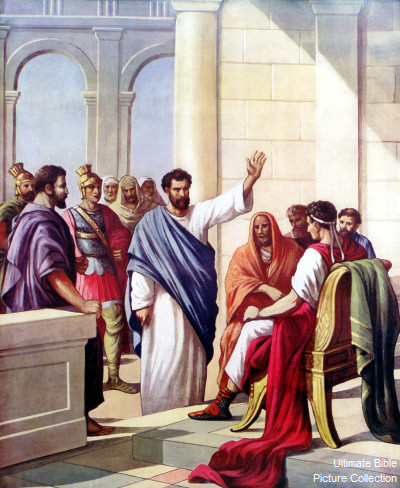 Felix
is recalled to Rome and replaced by Festus. He had no knowledge of the
Christian belief system. He wanted to ingratiate himself with the Jews
he was now governing. But Paul appeals to Caesar. Meanwhile, Herod
Agrippa II and his sister Bernice are interested in hearing about Paul's
case. His opinion was that Paul could have been released had he not
appealed to Caesar. Maybe Paul did this for the opportunity to preach
Christ in Rome. In fact, during the trial, Paul tried to induce Agrippa
to personally respond to the Gospel.
Felix
is recalled to Rome and replaced by Festus. He had no knowledge of the
Christian belief system. He wanted to ingratiate himself with the Jews
he was now governing. But Paul appeals to Caesar. Meanwhile, Herod
Agrippa II and his sister Bernice are interested in hearing about Paul's
case. His opinion was that Paul could have been released had he not
appealed to Caesar. Maybe Paul did this for the opportunity to preach
Christ in Rome. In fact, during the trial, Paul tried to induce Agrippa
to personally respond to the Gospel.Paul's says, “I put many saints in prison and when they were put to death I cast my vote against them.” Two possible meanings for this statement: a) Paul agreed with the death penalty. b) Paul was a former member of the Sanhedrin.
The clarity of Pauls' call from God and the role it played in his life led him to display tremendous perseverance. God still calls individuals to specific tasks and specific places.
Acts 27-28
Paul stays in Rome awaiting his hearing
We are in the last chapter of Acts. Luke does not tell us the outcome of Paul's appeal to Caesar.
The voyage from Caesarea to Rome was eventful:
- Luke and Aristarchus elect to go with Paul to Rome
- The Roman centurion, Julius, and Paul quickly develop a relationship of friendship and respect
- Paul was asked to play a part in the decision's made aboard ship
The story of the storm is like the story of Jonah in reverse; The presence of an obedient servant of God in the midst of unbelievers is often a great blessing to them.
The snake that bit Paul on Malta was a “sign” – “…(they) will pick up snakes with their hands and when they drink deadly poison it will not hurt them at all.”
“The First Man of Malta - title given by Publius” is an actual title verified by archaeology. It just shows how much Luke is a reliable historian.
When Paul arrives in Rome, he follows the same strategy as a prisoner that he did as a free man. He quickly convened the Jews and starts to reason with them. He then turns to the gentiles to proclaim the good news.
What happened to Paul? Tradition tells us that Paul died in Rome after the great fire (probably set by Nero himself) in 64 A.D., which Nero blamed on the Christians. The quote from Tacitus shows the hatred some had for the followers of “Christus.”
It is believed that Paul was released from his first imprisonment in Rome. Clement says Paul reached the limit of the west, which may mean he got to Spain. If so, Paul returned to Rome from Spain and Nero's persecution had begun. Paul was a primary target. He wrote his letters to Timothy and Titus during his second imprisonment. Then he was executed. Peter had already been crucified, but since Paul was a Roman citizen, he was most likely beheaded.
Joshua 1-2
Be strong and courageous
Joshua wrote most of the Book of Joshua. Joshua's name was originally 'Hoshea' meaning 'salvation'. Over the course of the exodus, his name is changed from Hoshea to Joshua, which means 'The Lord saves.' The Greek form of that name is Jesus.
God chose Joshua to be Israel's next leader. God always chooses his own leaders - the children of Moses did not succeed him. You may aspire to be a leader, but the decision is upon God.
God prepared Joshua to be the next leader of the nation of Israel. He did not wake up to be a leader, rather he was prepared as an apprentice by Moses.
The Book of Exodus records the story of how God brought Israel out of Egypt. The Book of Joshua records the story of how God brought Israel into the Promised Land. God always prepares you to go to a better place.
Knowing how Joshua felt when called upon to replace Moses, God gave Joshua 3 resources:
a. He reminds Joshua of the promise that went all the way back to Abraham: “I am about to give you every piece of land where you will set your foot...”
b. God gave Joshua a plan to follow.
c. He gave a promise: “I will be with you wherever you go.”
 The story of Rahab gives
us a few principles - there was no military reason for the spies to go
into Jericho, instead God chose to save a family out of Jericho to show
His love. The one He chose was a prostitute, who responded in faith.
Interestingly, God honors that women and makes her a direct ancestor of
Jesus Christ.
The story of Rahab gives
us a few principles - there was no military reason for the spies to go
into Jericho, instead God chose to save a family out of Jericho to show
His love. The one He chose was a prostitute, who responded in faith.
Interestingly, God honors that women and makes her a direct ancestor of
Jesus Christ.The scarlet cord points to the Cross. The story of Rahab is each of ours too. We are marked by the scarlet cord. We were chosen by God for his redemption. Not only does he rescue us from death in sin, he gives us the hope of an eternal life with him.
Joshua 3-5
Memorial stones
Israel had to camp before the Jordan River for 3 days before getting any specific instructions from God. The biggest question in everyone's mind must have been on the means of crossing the river Jordan. How will they get 2-3 million people across to the other bank?
The miracle of the drying up of the Jordan River is significant. Why did God do it? Why did he repeat the red sea miracle?
a. God did it for Joshua - he said "I will exalt you". What better way to prove that.
b. God did it for the nation of Israel.
c. God did it to impact the heathen nations in Canaan. He did this to demoralize the enemy.
What do the Memorial Stones teach us?
a. They were simple, but powerful, reminders of what God had done for them.
b. It is important to remember. Memorials are just as important for us as it was for Joshua's generation.
The whole army was circumcised before going into battle - seemingly such a stupid plan. The entire men are left incapacitated for a period of time, and supremely vulnerable. Why did God insist that they be circumcised? It was the mark of the covenant of God. It is analogous to baptism.
Colossians 2:11-12 Both circumcision and baptism mark a person out as bearing the covenant sign of God upon them – “This person is part of the family of God."
It is important to feed oneself from the Word of God, to study it, to be lead and guided by the Holy Spirit, and from that to be able to say, “This is what I believe and this is why I believe it.”
